Every examination must be evaluated for what it is, what it should be and not for what it was, what it could be. Primary duty is to avoid arbitrary results. Correct answers to questions presented in NEET-UG, 2018 was one of the 4 Options offered. Bi-lingual questions were set in English with an Option of an Additional Regional Language. Out of 13,23,672 Lakh Students, who appeared, 10.5 Lakh took it in English, 24 Thousand in Tamil. High Court of Madras noticed ‘mistranslations’ in Tamil in 49 questions. HC decided, those 24 Thousand were entitled to Grace Marks for those 49 questions, irrespective of whether they even attempted the ‘imperfectly translated’ questions. Result: 260 marks turned into 456; 137 – 333; 92 – 288; 21 – 217. Some who might have otherwise failed but for the Grace Marks, scored higher than those who gave the examination in English and Other Regional Languages.
Unprecedented, Unjustified, Unsustainable, Unacceptable. Set Aside.
It had been instructed by CBSE, “in case of ambiguity in translation of any of the questions, its English Version shall be treated as final.” This instruction was even stated in the Hall Ticket. There was no grievance whatsoever about the questions in English. 24 Thousand cannot unduly benefit for opting to give the examination in Tamil. Mistakes could have been detected and avoided.
– Hon’ble Justice S.A. Bobde, Central Board of Secondary Education v. T.K. Rangarajan, [Civil Appeal No. 11230 of 2018].
_____
My Lord, Example of ‘Mistake’ / ‘Ambiguity’ / ‘Imperfect Translation’ / ‘Mistranslation’ ?
Q. Incorrect Example of ‘Divergent Evolution’?
Forelimbs of Man, Bat and Cheetah.
Heart of Bat, Man and Cheetah.
Eye of Octopus, Bat and Man.
Brain of Bat, Man and Cheetah.
“In Tamil, ‘Cheetah’ was translated as ‘Sita’. It would have been obvious to apply common sense, Sita cannot occur in examples of Divergent Evolution. The error could have easily been answered by referring to the English Version.”
A. Eyes are an ‘Organ of Extreme Perfection’. Eyes of Humans and Octopi – Convergent Evolution. Octopi have no Blind Spot.

_____
06/05/2020
In Bihar Staff Selection Commission v. Arun Kumar, [Special Leave Petition (Civil) Nos. 23202-23204 of 2015] the grievance about 2 questions was justified.
Q 107. Which term comes next in the series: YEB, WFD, UHG, SKL?
QGL.
TOL.
QNL.
QOL.
A. No Correct Option.
Q. 125. Given the statement: “all windows are doors and no door is wall’…
no window is wall.
no wall is door.
some windows are walls.
A. Two Correct Options.
_____
23/07/2024
Court requested Director of IIT, Delhi to constitute a Three-Member Committee and a Three-Member Committee from Department of Physics comprising of (i) Professor Pradipta Ghosh; (ii) Professor Aditya Narain Agnihotri; and (iii) Professor Sankalpa Ghosh was constituted. Expert Team opined, Option (4) is correct.
– Three-Judge Bench, Vanishka Yadav v. Union of India, [Writ Petition (Civil) No. 335 of 2024].

02/08/2024
“The recalibration of ranks was necessary to reflect true merit, correcting any distortions caused by earlier inclusion of an incorrect answer.”
NEET is divided into 4 segments comprising Physics, Chemistry, Botany and Zoology. Each of 4 segments contains 45 questions. A total of 180 questions, thus, to be answered in 3 hours and 20 minutes. 4 marks are awarded for every question which is attempted correctly and 1 mark is subtracted for each incorrect answer; questions which are not attempted attract neither positive nor negative marks. NEET carries a maximum of 720 marks, thus.
From observations of this Court in Bihar School Examination Board v. Subhas Chandra Sinha, (1970) 1 SCC 648 it can be seen, number or proportion of students who can be believed to have indulged in malpractice is a relevant factor.
Sachin Kumar v. Delhi Subordinate Service Selection Board, (2021) 4 SCC 631 made pertinent observations. Courts are required to assess extent of use of unfair means and whether it is possible to separate tainted and untainted candidates. There must be a real possibility of systemic malaise as borne out by material before Court. There was abundance of material before Court in Sachin Kumar, sufficient to conclude mass malpractice.
In present case, there are no deviations which indicate systemic cheating has taken place. The information before us at this stage does not show, the question paper was disseminated widely or the answers were being communicated to students using sophisticated electronic means which may prove difficult to trace. It is possible to separate beneficiaries of malpractice or fraud from those honest. Court cannot direct a re-exam.
– Hon’ble Chief Justice of India, Hon’ble Justice Dr. D.Y. Chandrachud, Vanishka Yadav v. Union of India, [Writ Petition (Civil) No 335 of 2024].
_____
Board of High School and Intermediate Education, U.P., Allahabad v. Ghanshyam Das Gupta, AIR 1962 SC 1110; Bihar School Examination Board v. Subhas Chandra Sinha, (1970) 1 SCC 648; Anamica Mishra v. U.P. Public Service Commission, Allahabad, (1990) Supp SCC 692; Madhyamic Shiksha Mandal, M.P. v. Abhilash Shiksha Prasar Samiti, (1998) 9 SCC 236; Union of India v. Rajesh P.U., Puthuvalnikathu, (2003) 7 SCC 285; Inderpreet Singh Kahlon v. State of Punjab, (2006) 11 SCC 356; Chairman, All India Railways Recruitment Board v. K. Shyam Kumar, (2010) 6 SCC 614; Joginder Pal v. State of Punjab, (2014) 6 SCC 644; Gohil Vishvaraj Hanubhai v. State of Gujarat, (2017) 13 SCC 621; Sachin Kumar v. DSSSB, (2021) 4 SCC 631; State of Tamil Nadu v. A. Kalaimani, (2021) 16 SCC 217; Vanshika Yadav v. Union of India, (2024) 9 SCC 743.
When an in-depth factual inquiry reveals systemic irregularities, result should be cancelled in its entirety. However, if and when possible, segregation of tainted and untainted candidates should be done in consonance with fairness and equity. It is not necessary for material collected to conclusively prove malpractice beyond a reasonable doubt. The standard of evidence should be reasonable certainty of systemic malaise. The probability test is applicable. An individual notice and hearing may not be necessary in all cases for practical reasons when facts establish, entire selection process is vitiated with illegalities at a large scale.
– Hon’ble Chief Justice of India, Hon’ble Justice Sanjiv Khanna, State of West Bengal v. Baishakhi Bhattacharya (Chatterjee), [Special Leave Petition (Civil) No. 9586 of 2024] decided on 03.04.2025.
_____
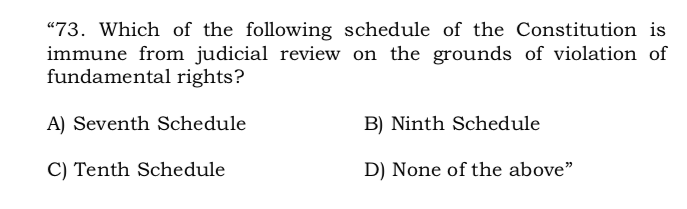
According to Learned Single Judge, Recruiting Body was right by mentioning Option ‘B’ as correct. Division Bench held, Option ‘D’ was legally correct and aligned with settled position of law as laid down by this Court. When Judges of a High Court are at variance as to Question No. 73, it is least expected from mere Law Graduates who are competing for a post of Law Officer. From a Law Graduate’s point of view, Option ‘B’ appears to be more appropriate. However, on a deeper analysis, Option ‘D’ can also be considered to be correct.
– Hon’ble Justice Prashant Kumar Mishra, Charan Preet Singh v. Municipal Corporation, Chandigarh, [Civil Appeal No. 3446 of 2026] decided on 17.03.2026.

 The Last Word
You must be logged in to post a comment.